

Staying dry, without leaving a trace
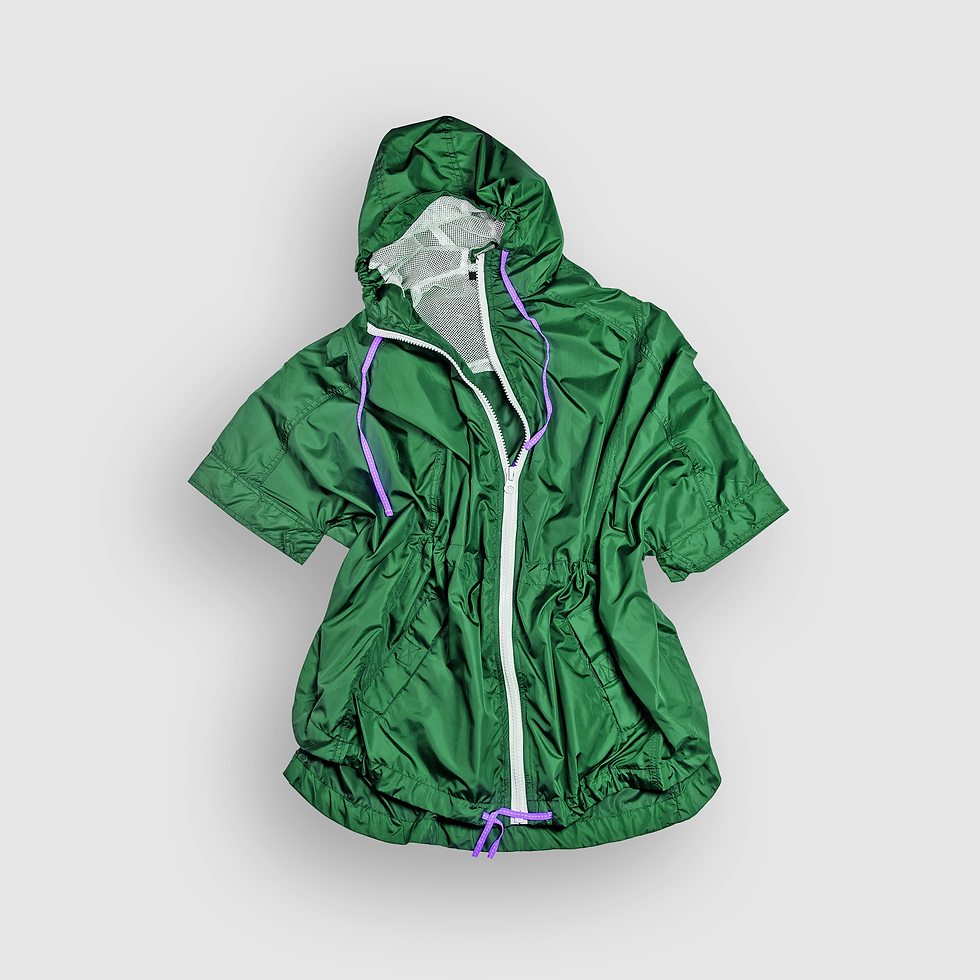
There’s a particular kind of confidence that comes from a good rain jacket. You send a child to school on a wet morning and don’t worry about the walk from the car to the gate. You step onto a ferry deck or a worksite or a windswept platform and trust that your clothes will do their quiet job. You don’t think about the fabric at all; only about the weather, and how little it’s managing to interrupt your day.
That “quiet job” is harder than it looks. A textile has to repel water without feeling like plastic. It has to keep repelling water after weeks of abrasion, flexing, grime and repeated washing. It has to work in thin layers, on moving bodies, in cold, wind and rain that finds every seam. And for a long time, the industry’s most reliable way to deliver that performance leaned on a family of chemistries prized for the very thing that makes them controversial: they don’t break down easily.
Most people encounter this only as a feature list: “water-repellent,” “stain-resistant,” “easy care.” But the chemistry that makes water bead and roll away is not a cosmetic detail. It’s a deliberate surface engineering strategy: change how fibres interact with water, lower the surface energy, make wetting less likely. Historically, fluorinated chemistries have been unusually effective at this. They’ve also proven unusually persistent, which is why PFAS restrictions and phase-outs are accelerating across uses, including textiles. The uncomfortable truth is that many PFAS-free alternatives still struggle to match the same balance of durability and performance, especially for demanding outdoor and technical applications.
This is the tension BioSusTex is stepping into: people still need outerwear, kids still need rain gear, workers still need protective clothing and “just accept worse performance” isn’t a credible plan. The only path that really holds is to make PFAS-free repellency that works, then prove it works under realistic conditions.
BioSusTex aims to develop a PFAS-free water-repellent coating built from bio-based components (i.e. surfactants and binders with high bio-based content) designed to deliver durable water repellency while moving away from “forever chemistry.” It also highlights a practical challenge that rarely makes it into sustainability claims: it’s not enough to make a fabric hydrophobic on day one. The formulation has to behave in manufacturing (apply evenly, cure properly), and then keep behaving through wear, laundering and time.
That’s why the story here isn’t simply “replace chemical X with chemical Y.” It’s about rebuilding the whole mechanism of repellency so that it can be both effective and more compatible with long-term environmental goals. The proposal gives a glimpse of what that rebuilding can look like: new formulations based on waxes and fatty acids, new surfactant systems to create stable emulsions (so coatings can be applied consistently), and approaches that consider what happens during drying and curing, because those steps can make or break a finish’s performance.
The phrase “durable water repellency” is a clue: durability is the entire game. A finish that performs beautifully once but fails after a few washes doesn’t reduce impact; it increases turnover, disappointment and replacement. BioSusTex positions its work around achieving functional performance while avoiding the familiar trap of regrettable substitutions, by pairing development with safety and sustainability assessment methods throughout the process.
There’s another practical layer to this, too: textile finishes don’t live in isolation. The coating has to work on real fabrics, alongside dyes, prints and other treatments. It has to be compatible with manufacturing lines, and it has to be measurable so claims can be tested, compared and trusted. BioSusTex sets out a path that includes validation in relevant environments and a progression in maturity (moving beyond “it works in principle” toward “it works in practice”).
All of this is in service of something very ordinary: staying dry.
A kid’s rain jacket isn’t a chemistry project. Work trousers aren’t a policy debate. They are everyday tools. BioSusTex treats that ordinariness as the standard to meet, because if the most common uses of water-repellent textiles can shift away from persistent chemistries without losing the performance people depend on, the change doesn’t feel like sacrifice. It just feels like progress happening quietly in the background.